Proving Ethereum in Real Time on 4 GPUs
We are excited to announce OpenVM 2.1 Preview, an early look at OpenVM’s performance trajectory. OpenVM 2.1 Preview marks another step change in OpenVM’s performance: it now proves Ethereum mainnet blocks in real time on only 4 5090 GPUs, delivering a p99 proving time of 9.7s with half the hardware that OpenVM 2.0 required. It remains the fastest zkVM on EthProofs, where we are demonstrating its performance live.
OpenVM 2.1 Preview is available under the MIT and Apache 2.0 licenses on GitHub. We are particularly excited to see its impact on Ethereum scaling. OpenVM performance is now improving more rapidly than the Ethereum gas limit is increasing, which can enable it to play a role in increasing throughput in Ethereum’s ZK-based scaling roadmap. As a preview release, it is an indication of where OpenVM is going and should not be used for production, where we recommend our existing OpenVM 2.0 release.
Delivering Frontier Performance
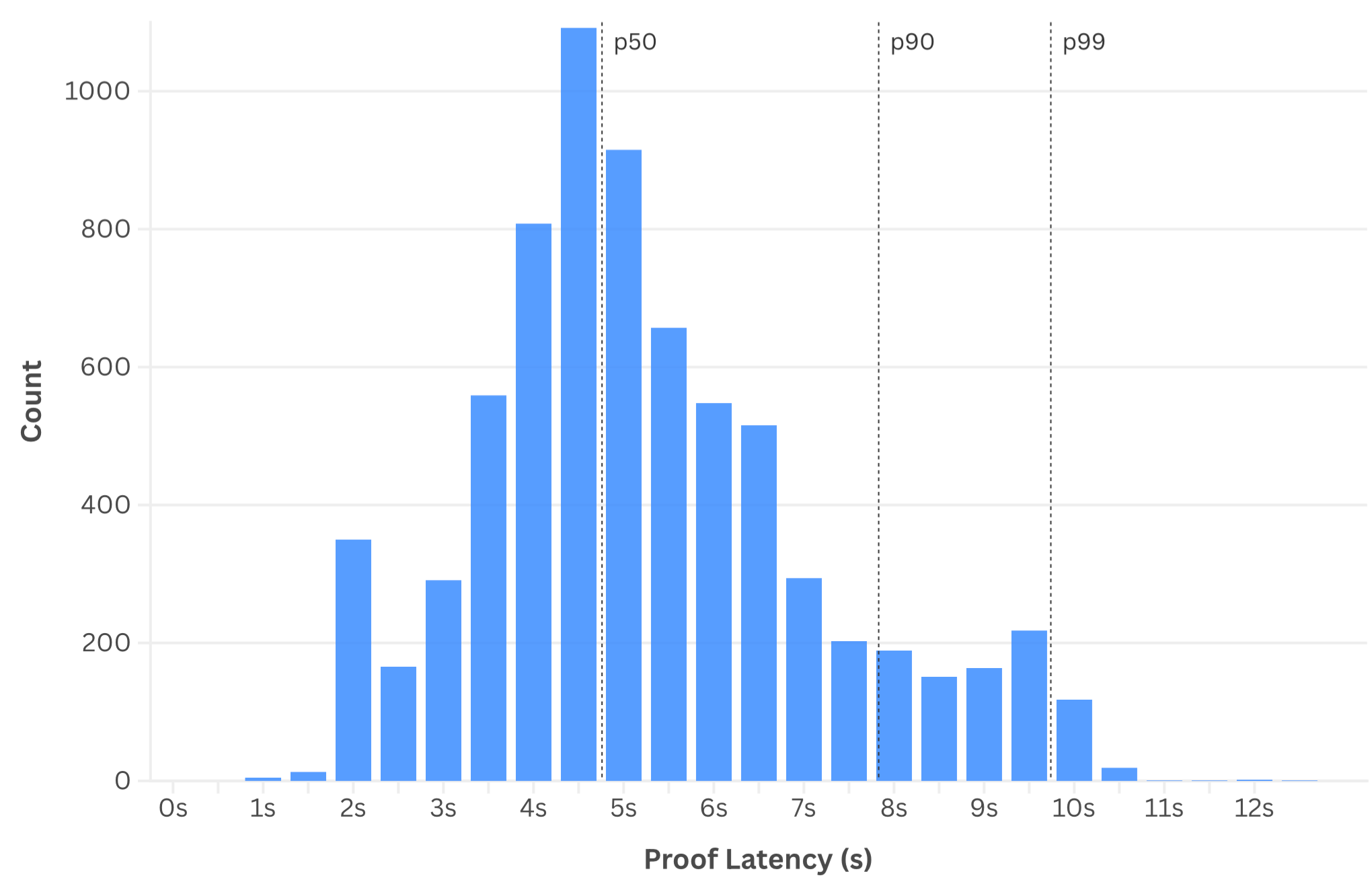
OpenVM 2.1 Preview dramatically improves proving performance from the OpenVM 2.0 production release 3 weeks ago. With the same 100-bit provable security and sub-300kB proof sizes, it proves Ethereum mainnet blocks in real time (i.e. within the Ethereum block time) on only four 5090 GPUs, with a p99 proving time of 9.7s and an average time of 5.0s over 7,200 blocks starting from block 24,000,000. This is half the hardware that OpenVM 2.0 required and makes real-time proving accessible on a single workstation.
On 16 GPUs, OpenVM 2.1 Preview delivers an average proving time of 2.4s and a p99 time of 3.7s. This represents around 4x the throughput needed to prove today’s Ethereum in real time and roughly 1.7x the performance of OpenVM 2.0, which proves at an average time of 3.9s and a p99 time of 6.3s over the same stretch of blocks on 16 GPUs. We are demonstrating the performance of this 16-GPU cluster live on EthProofs, where OpenVM is the fastest participating zkVM.
The performance leap largely comes from a new execution approach based on portable native recompilation: rather than translating the RISC-V binary directly into host assembly, OpenVM emits portable C and compiles it into a native library that runs on the host CPU to benefit from C compiler optimizations. This release also supports the 64-bit RISC-V target RV64IM_Zicclsm proposed by the Ethereum Foundation for zkVMs proving Ethereum. To learn more, read the full details at the OpenVM announcement blog.
Why the Performance Matters
The Ethereum Foundation protocol team recently published the strawmap, a draft roadmap for Ethereum L1. The north star for execution throughput is gigagas L1: one gigagas per second of throughput on the base layer. The approach to achieve this is to replace today’s validation through re-execution by verification of ZK proofs.
OpenVM 2.1 Preview’s ability to prove today's Ethereum on 4 GPUs instead of 16 directly contributes to this ambition. Real-time proving on fewer GPUs and higher-gas proving on more GPUs are the same capability measured two ways: the hardware that OpenVM 2.1 Preview no longer needs for today's blocks is hardware available for proving much larger blocks, which enables Ethereum to scale its gas limit safely and sustainably.
The pace of improvement matters as much as the absolute number. Ethereum’s Glamsterdam update targets a gas limit of 200M, 3.3x the 60M limit today, while OpenVM 2.1 Preview already proves at roughly 4x the throughput that real-time proving requires. We are accelerating proving speed faster than Ethereum is raising its gas limit, and as long as that holds, ZK is not a constraint on how fast Ethereum can scale but the reason it can scale faster.
What’s Next
We believe cryptographic systems like OpenVM should be as performant and as secure as the future demands them. The bar for both is rising: Ethereum is scaling to bring more volume and use cases on-chain, and AI is making attackers faster and more capable. This release reflects our work on performance, but deploying to production requires commensurate innovation on security. We will have more to share on that front soon.
In the meantime, you can see the full release on GitHub. To stay updated or get involved, join us on Telegram or follow us on X.