Proving Ethereum in Real Time with OpenVM 2.0
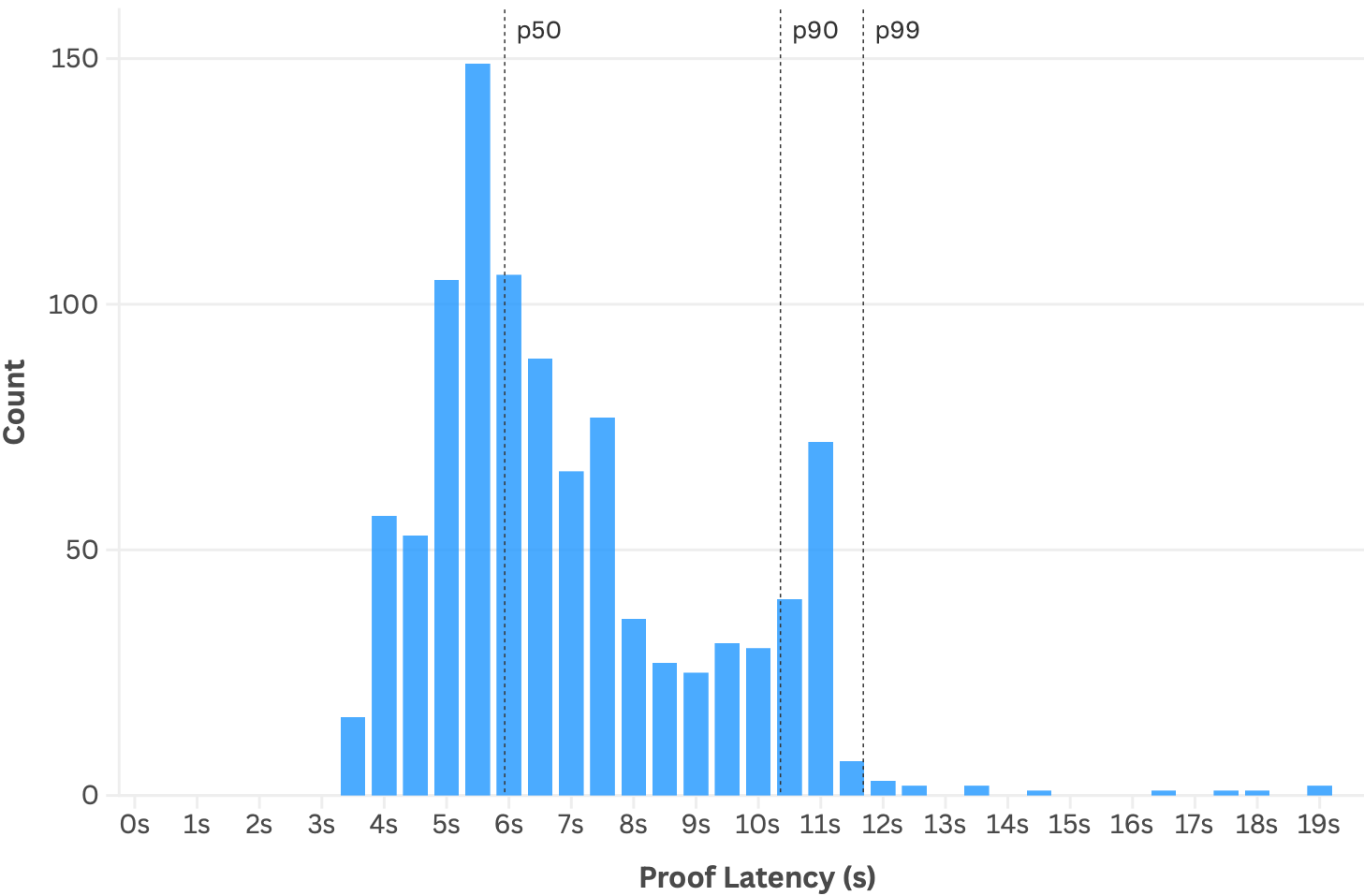
We’re excited to announce that Axiom is proving Ethereum in real time with OpenVM 2.0 on the Axiom Proving API. OpenVM 2.0 proves Ethereum mainnet blocks in a p99 time of 11.8s on 16 5090 GPUs and features 100-bit provable security and proof sizes under 300 kB. To learn more about OpenVM 2.0 and the new SWIRL proof system underlying its performance, check out the OpenVM 2.0 announcement and the SWIRL whitepaper.
While this release achieves a long-standing goal for blockchain scalability, its implications extend further. OpenVM 2.0 proves the standard CoreMark benchmark for embedded CPUs at 139 MHz on 16 5090 GPUs. This performance is comparable to a physical embedded processor, meaning that developers can prove complex logic at speeds practical for real-world use cases. This opens up verifiable computing as a performant general-purpose primitive for applications like verifiable AI, financial systems of record, or identity verification.
Scaling Ethereum with OpenVM
OpenVM 2.0 is a step function improvement in our ability to prove Ethereum execution. By combining the high-throughput proving of OpenVM 2.0 and the low-latency recursion of SWIRL, we are able to prove Ethereum mainnet at p99 level on a cluster of 16 5090 GPUs. As shown below by the histogram of proving times for 1000 blocks starting from block 24,000,000, this makes the vision of fully SNARK-ified Ethereum execution a reality.
With this milestone, we have achieved the performance targets set by the Ethereum Foundation for an L1 zkEVM. This is a critical step towards removing execution as a bottleneck in Ethereum consensus, and we look forward to continuing this work to scale Ethereum with OpenVM as we push toward formal verification, 128-bit security, and client integrations.
Building with OpenVM
Over the past few months, we have been working with a small cohort of early partners to build verifiable applications with OpenVM 2.0. We’ve found that bringing the bleeding-edge performance of OpenVM to production requires deep integration at the product design and infrastructure levels.
To support this, our team has been engaging directly across the stack to ensure customer success, operating as an extension of our partners' engineering teams. These engagements cover the full lifecycle of a ZK integration:
- Product Design: We help architect ZK native applications from day one. By optimizing data structures and business logic for ZK proving, we empower partners to enhance their applications with privacy and verifiability without compromising user experience or incurring excess cost.
- Custom Acceleration: While OpenVM supports general-purpose Rust code out of the box, we work with partners to identify performance bottlenecks in their specific business logic and accelerate these critical operations with custom OpenVM extensions.
- Prover Orchestration: Realizing real-time performance in production requires substantial infrastructure and deployment expertise. We handle the complexity of operating proving infrastructure at scale through the Axiom Proving API by managing GPU orchestration and uptime for mission-critical workloads.
OpenVM 2.0 will be available shortly in preview on the Axiom Proving API, with a full production release scheduled following the completion of internal and external security audits. With this release, we are excited to work directly with a broader range of partners to bring the performance and security benefits of OpenVM to their products. If your team is looking for deep integration support to make your application verifiable with the power of zero-knowledge, get in touch to chat about how Axiom can help supercharge it with OpenVM 2.0.
To try OpenVM today, check out the developer docs and Github, learn more from the new SWIRL whitepaper, and join the developer chat on Telegram for technical discussion. We’re excited to continue pushing the boundaries of what’s possible with ZK.